

For most of its life, the Tour de France has asked fans to do one thing: watch.
You either stood on the side of a road for half a day to see the race flash past in thirty seconds, or you watched it on television and pretended your couch was a magic corporate box following the peloton. Either way, the race happened somewhere else. You were simply a spectator. Maybe a very invested one. Maybe one yelling at the screen as if Tadej Pogačar could hear you from a lounge room in the suburbs. But still, a spectator.
The line got crossed this year
That’s no longer true, and I don’t think the sport has clocked what it really means. This July, for the first time, you can ride the stage that morning and watch it in real time a few hours later. In other words, it’s not a nearby road, but the same one.
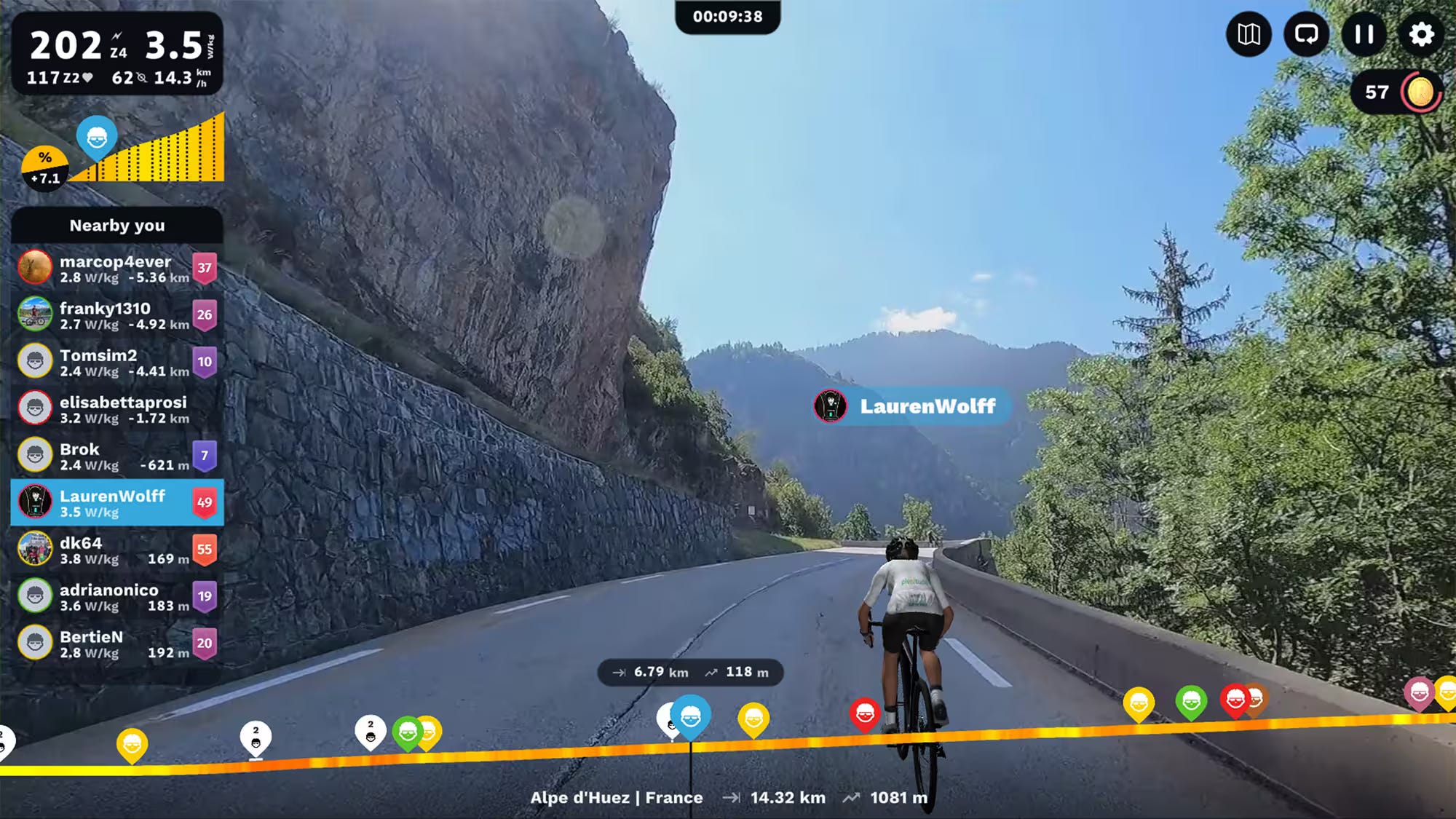
If you have been paying attention, you’ll know that this has been creeping up on us for a while. Virtual platforms have flirted with the Tour in one way or another for years. Zwift ran a cut-down version a few years back, when a digital version was the only option anyone had. Now, 2026 is the year the pieces actually click into one continuous experience, rather than a gimmick bolted onto the broadcast.
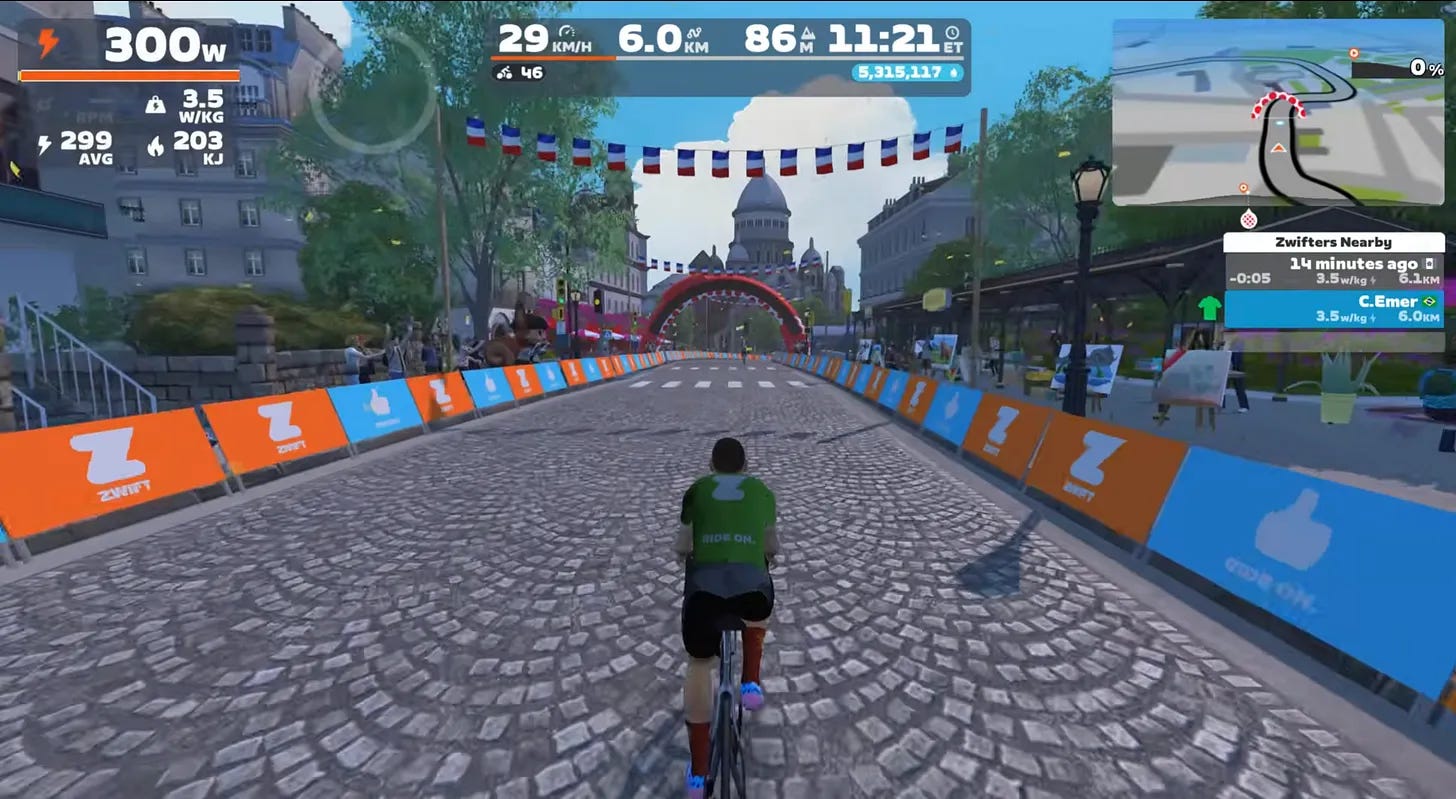
Take the most literal example. On June 26, Zwift switched on its expanded Paris map, crowned by the cobbled climb to the Sacré-Cœur in Montmartre, the exact climb that decides the final stage on 26th of July. So here’s the sequence that’s now possible: watch the pros hit those cobbles on the last Sunday of the Tour, then ride the same corners, the same gradient, the same run to the line, in your spare room that same day. Compare notes afterwards. The gap between watching and doing has shrunk to about the length of your hallway.
Zwift’s built a whole season around it. The Tour Fever Challenge runs July 2 to August 16. Five stages of rides and races across the new Paris roads, timed to shadow both the men’s race and the Tour de France Femmes avec Zwift. Before that, the L’Étape Challenge spent June serving up four of the climbs from this year’s Queen Stage, in the order the pros meet them.
However, before anyone gives Zwift too much credit, it’s worth being honest about the scale of what’s actually on offer. The Montmartre cobbles are the only genuinely new stage climb Zwift has bothered to replicate, on top of the long-standing Alpe du Zwift, which is a turn-by-turn GPS model of Alpe d’Huez’s front side (the back side, apparently, can wait). Sure, plenty of this year’s Tour climbs sit somewhere in Zwift’s climbing portal. But the flat, slightly sterile presentation barely lifts those routes above a data-driven training file, something you could just as easily load into any workout app. It’s not really the same thing, and it shouldn’t be sold as such.
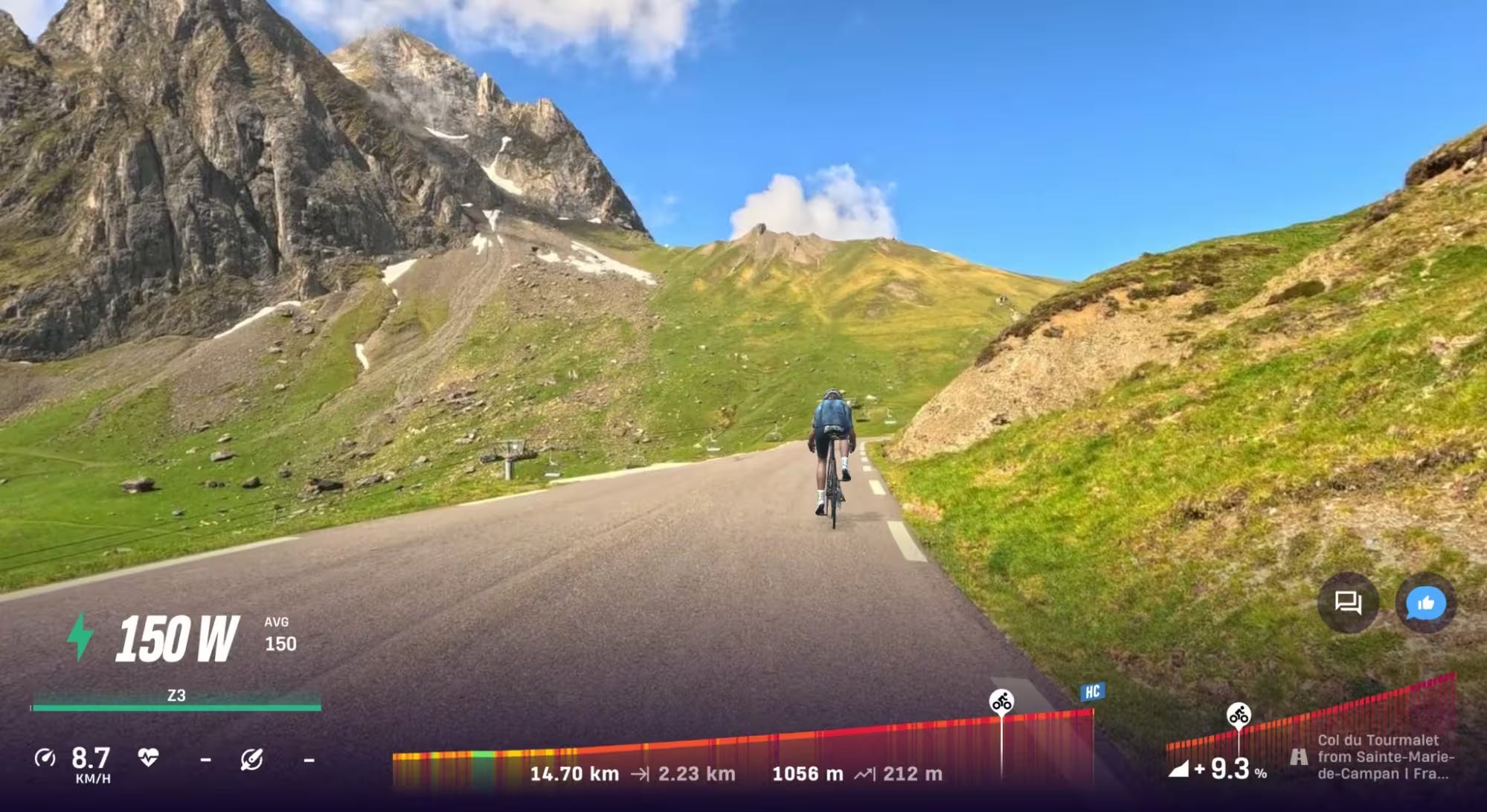
Rouvy comes at it from the other direction, and in many ways more powerfully. Because Rouvy is real filmed roads rather than a rendered world, riding a Tour climb on Rouvy isn’t a tribute; it’s the actual tarmac, the actual hairpins, filmed on the actual mountains. That makes the platform’s route previews from the 2026 course, and its challenges built on real segments from this year’s stages, feel even more immediate. “I rode today’s stage” ceases to be a figure of speech.
Why this is bigger than we think
It would be easy to file all this under “brand activation” and move on. But that misses the point, and here’s why.
There aren’t many sports that can do this. You cannot play the World Cup’s latest match after it’s finished. You can’t bat an over at the MCG during the Boxing Day Test. But cycling’s playing field is public roads and reproducible physics: power, gradient, drag, which means the sport’s arena can be copied and handed to anyone with a trainer. Cycling has spent a century envying stadium sports their broadcast money. It turns out cycling owns something better: an arena that duplicates.
It changes the feeling in a way that is difficult to describe. When you’ve ridden Montmartre’s cobbles yourself, even virtually and even with a quarter of the watts, you don’t watch the pros climb it the same way. You know where it kicks. You know the corners where your legs screamed at you to stop. Every armchair fan becomes a fan with skin in the game, and that’s the deepest hook any sport can get. It’s the difference between admiring a magic trick and having tried the trick yourself.
Credit: @oldnapalm (Youtube)
Third, it quietly solves the Tour’s oldest problem: it’s a three-week festival that leaves nothing behind for the fan to do. The Tour has always converted inspiration into bike-shop sales and little else. Now there’s a direct pipe: watch the stage, ride the stage, attempt the effort, chase the badge, and come back again tomorrow. The Tour becomes a three-week training block with the world’s best pacing footage and inspiration.
The honest understanding
A virtual Montmartre is not Montmartre: no crowd noise, no fear on the descents, no smell of July tarmac, of the sizzling heat, shivering cold or driving rain, and your avatar never has to eat 120 grams of carbs an hour in a crosswind. Riding a stage’s marquee climb is not riding a 180km stage; nobody’s doing the full Queen Stage before work. And there’s a commercial engine under all this romance: Zwift pays to be the Tour’s official platform precisely because July is when lapsed subscribers can be genuinely lured back. The participation revolution is also a retention strategy. Both things are true.


There’s also a slightly melancholy version of this piece, where “ride the Tour from your living room” becomes one more reason nobody stands on a mountainside for half a day with a flag. Are the people painting names on the Galibier ever going to swap the real-life experience for a trainer in their garage? I highly doubt it, but it’s worth saying out loud.
The point
None of those caveats changes the main point: the game is changing in July. The 2026 Tour is the first time the distance between the race and its fans won’t be measured by barriers and broadcast rights, but in whether you feel like riding tonight. That’s the ending point: the race is no longer just something to watch, but something you can experience.
For a hundred years the Tour asked one thing of us: watch. This one asks a better question: want a go? That’s the point, and it’s why the finish feels different.
My answer’s yes. I’ll be on the Montmartre cobbles on the final Sunday, a few hours after the pros, several watts short and entirely satisfied about it. Come find me there; it’s the first Tour de France with room for all of us on the course. That’s where this ends: not with watching, but with joining in.